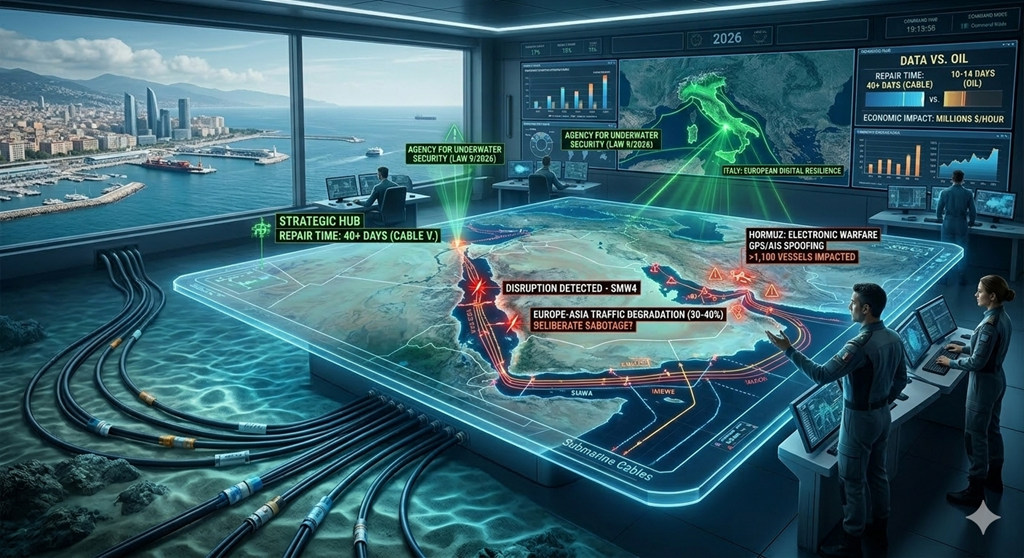
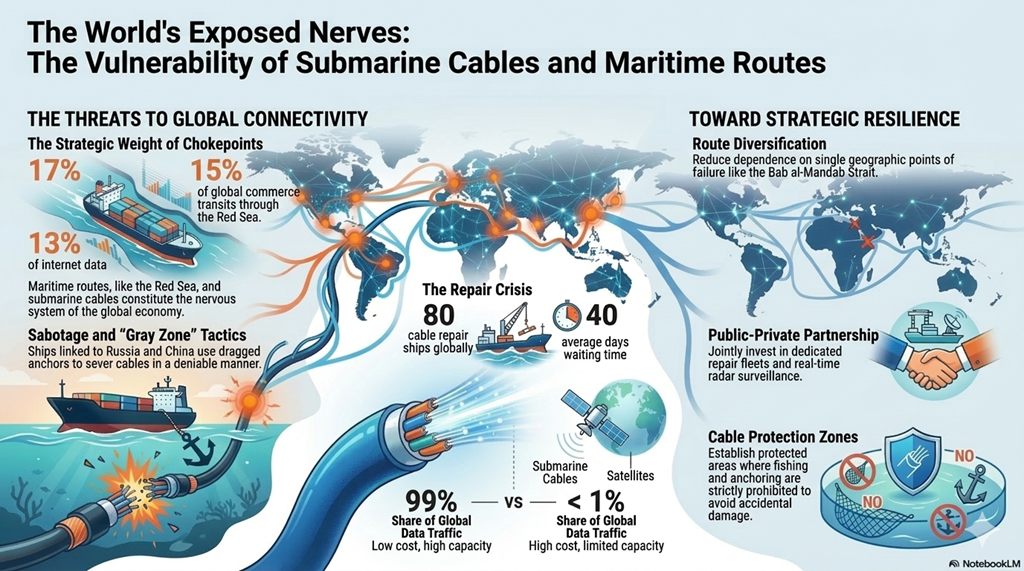
While global geopolitical attention often focuses on the flow of crude oil, a deeper realization emerges in 2026: the true backbone of the modern economy does not flow through oil tankers, but through the undersea cables that carry over 99% of intercontinental data traffic. If oil is the energy of the past, data is the black gold of the present, and the maritime chokepoints of the Middle East are its most vulnerable guardians.
The Red Sea: A bottleneck caused by 17 Cables
The Red Sea is not only a maritime route for 15% of global trade; it is a corridor through which approximately 21 submarine cable systems pass. This geographical concentration creates a single point of failure: it is estimated that between 30% and 40% of internet traffic between Europe, Asia, and Africa depends on this narrow strip of sea.
Recent incidents have confirmed the fragility of this network. Between late 2025 and early 2026, damage to the SMW4, IMEWE, and FALCON cables caused massive slowdowns in India, Pakistan, and Kuwait. Although many outages are accidental, caused by anchors or fishing nets, the climate of geopolitical tension constantly raises suspicions of deliberate sabotage as part of hybrid campaigns.
Beyond Missiles: Electronic warfare in the Strait of Hormuz
While the Red Sea faces physical threats, the Strait of Hormuz has become the scene of a new form of conflict: electronic warfare. Reports from March 2026 indicate that over 1,100 ships have experienced disruptions to their GPS signals and Automatic Identification Systems (AIS). This electronic “spoofing” not only jeopardizes physical navigation by increasing the likelihood of collisions, but also compromises the integrity of the data necessary for global logistics management.
Oil vs. Data: The Real Comparison
Many analysts argue that a data crisis is more dangerous today than an oil crisis.
- Redundancy: While oil can rely on strategic reserves and established alternative routes (such as the route around Africa), undersea cables have limited redundancy, and satellite routes can replace only a tiny fraction of the lost bandwidth.
- Repair Times: A hijacked oil tanker adds 10-14 days to the voyage; repairing a cable in a conflict zone can take more than 40 days, due to a shortage of specialized cable-laying vessels and delays in obtaining diplomatic permits.
- Economic impact: A prolonged digital blackout would result in losses of millions of dollars per hour, crippling cloud services, financial transactions, and the Internet of Things (IoT).
Europe’s Response and Italy’s Role
The European Union has stepped up its security measures with the Cable Security Toolbox, unveiled in February 2026, which aims to mitigate risks associated with high-risk suppliers and identify critical dependencies.
In this context, Italy occupies a key strategic position. With the entry into force of Law No. 9 of January 26, 2026, the country established the Agency for the Safety of Underwater Activities, assuming a leading role in the Mediterranean for the monitoring and restoration of critical infrastructure. Italy’s goal is to transform its geographical centrality into a competitive advantage, becoming the natural hub for the landing of cables connecting the Indo-Pacific to Europe.
Conclusion
The future of European digital sovereignty hinges on the seabed. Protecting the “invisible highways” of the Red Sea and the Strait of Hormuz is no longer just a technical task for telecommunications operators, but a national security priority. In a world where control over data is synonymous with power, the resilience of undersea infrastructure will be the determining factor for economic stability in the coming decade.